
“Cifiafo, cofomefe stafaifi?”
Se da bambino hai pronunciato almeno una volta una frase del genere, probabilmente conosci già l’alfabeto farfallino.
Per molti è un ricordo delle scuole elementari, un modo per parlare senza farsi capire da fratelli, compagni di classe o genitori. Bastava una regola molto semplice: dopo ogni vocale si aggiungevano una f e la stessa vocale. Così ciao diventava cifiafaofo e, per chi non conosceva il trucco, tutto sembrava improvvisamente incomprensibile.
L’alfabeto farfallino ci dimostra che gli esseri umani inventano lingue da sempre.
Quando sentiamo parlare di lingue inventate, pensiamo subito all’esperanto o alle lingue dei film fantasy.
In realtà il fenomeno è molto più ampio.
Secondo Treccani, una lingua inventata è un sistema linguistico creato artificialmente, con regole proprie e, a volte, anche un vocabolario originale. Le motivazioni possono essere moltissime: comunicare meglio, giocare, raccontare una storia, costruire un mondo immaginario oppure creare un codice condiviso con un piccolo gruppo di persone.
Ed è proprio qui che si inserisce l’alfabeto farfallino: non nasce per sostituire l’italiano, ma per camuffarlo.
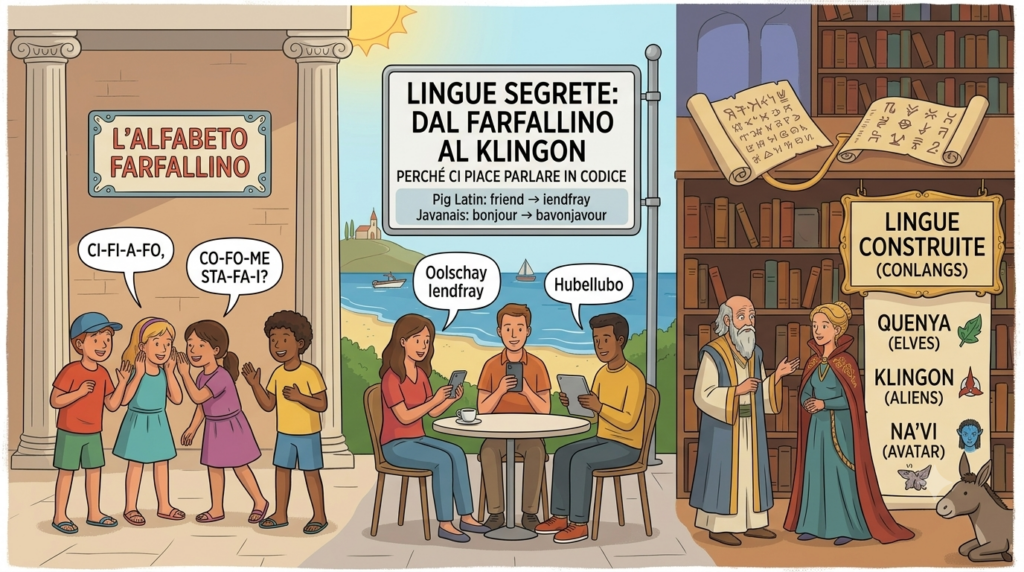
Alcune lingue inventate servono semplicemente a divertirsi o a parlare in codice tra amici, come l’alfabeto farfallino. Altre, invece, sono state progettate per dare vita a mondi immaginari così credibili da sembrare reali.
In entrambi i casi, l’idea di base è la stessa: prendere una lingua che conosciamo e trasformarla seguendo regole precise.
In inglese, ad esempio, è famoso il Pig Latin. La regola più comune consiste nello spostare l’inizio della parola alla fine e aggiungere -ay: così school diventa oolschay e friend si trasforma in iendfray.
Sempre nel mondo anglosassone esiste anche l’Ubbi Dubbi, in cui si inserisce la sillaba ub prima di ogni vocale: hello diventa hubellubo e fun diventa fubun.
In Francia, invece, c’è il Javanais. Qui si aggiunge la sillaba av dopo alcune consonanti, trasformando ad esempio bonjour in bavonjavour. È stato usato per molto tempo come linguaggio in codice tra bambini e ragazzi.
Nei Paesi di lingua spagnola è diffusa la Jerigonza, che ricorda molto il nostro alfabeto farfallino: dopo ogni vocale si inseriscono una p e la stessa vocale. Così hola diventa hopolapa e amigo si trasforma in apamipigopo.
Ma c’è anche chi ha fatto un passo in più.
Scrittori e linguisti hanno creato lingue complete, con grammatica, lessico e regole di pronuncia, per dare maggiore profondità ai mondi della fantasia. È il caso del Quenya e del Sindarin, le lingue degli elfi ideate da J.R.R. Tolkien, del klingon di Star Trek o del na’vi di Avatar. Si tratta di sistemi linguistici veri e propri, tanto che oggi esistono persone che li studiano e li parlano davvero.
L’alfabeto farfallino nasce per divertirsi, ma racconta un aspetto molto umano: appena impariamo una lingua, ci viene subito voglia di piegarla alle nostre regole.
Cambiamo le parole, inventiamo codici, aggiungiamo suoni e sillabe. Lo facciamo da bambini, ma anche da adulti, quando scriviamo messaggi pieni di abbreviazioni o creiamo modi di dire comprensibili solo a chi ci conosce molto bene.
Chissà, magari da qualche parte c’è ancora qualcuno che ogni tanto saluta gli amici con un cifiafo.
Ascolta l’articolo in inglese mentre lo leggi
If you’re Italian, chances are you’ve come across the Farfallino alphabet in your childhood.
For many Italians, it’s a fond memory—a playful way to talk without being understood by siblings, classmates, or parents. The rule was incredibly simple: after every vowel, you added an f followed by the same vowel. So ciao became cifiafaofo, and to anyone who didn’t know the trick, it suddenly sounded like complete gibberish.
The Farfallino alphabet is a reminder that humans have been inventing languages for a very long time.
When people hear the phrase invented language, they usually think of Esperanto or the fictional languages from fantasy films and novels.
But the phenomenon is much broader than that.
According to the Treccani dictionary, an invented language is a linguistic system created artificially, complete with its own rules and, in some cases, its own vocabulary. People invent languages for all kinds of reasons: to communicate more effectively, to play games, to tell stories, to build imaginary worlds, or simply to create a code that only a small group of people can understand.
That’s exactly where the Farfallino alphabet fits in. It wasn’t created to replace Italian—it was created to disguise it.
Some invented languages exist simply for fun or to let friends communicate in secret, like the Farfallino alphabet. Others were designed to make imaginary worlds feel so rich and believable that they almost seem real.
In both cases, the basic idea is the same: take a language you already know and reshape it according to a set of rules.
In English, for example, Pig Latin is a classic. The most common rule is to move the beginning of a word to the end and add -ay. That’s how school becomes oolschay, while friend turns into iendfray.
The English-speaking world also has Ubbi Dubbi, where the syllable ub is inserted before every vowel. As a result, hello becomes hubellubo, and fun turns into fubun.
In France, there’s Javanais, where speakers insert the syllable av after certain consonants. For example, bonjour becomes bavonjavour. For many years, it was widely used by children and teenagers as a secret code.
Across the Spanish-speaking world, you’ll find Jerigonza, which is remarkably similar to the Italian Farfallino alphabet. The rule is to insert a p followed by the same vowel after every vowel, so hola becomes hopolapa, while amigo turns into apamipigopo.
Then there are those who took the idea much further.
Writers and linguists have created fully developed languages—with their own grammar, vocabulary, and pronunciation—to give fictional worlds greater depth and realism. Famous examples include Quenya and Sindarin, the Elvish languages created by J.R.R. Tolkien, Klingon from Star Trek, and Na’vi from Avatar.
These aren’t just made-up words. They’re complete linguistic systems, and today there are communities of people who study them, speak them, and even hold conversations in them.
The Farfallino alphabet may have started as a children’s game, but it reveals something deeply human.
As soon as we learn a language, we begin finding ways to make it our own.
We change words, invent codes, add new sounds and syllables. We do it as children, and we keep doing it as adults—whether we’re filling text messages with abbreviations or coming up with expressions that only our closest friends understand.
Who knows? Somewhere out there, someone probably still greets their friends with a cheerful cifiafo.
Ascolta l’articolo in francese mentre lo leggi
Si vous êtes Italien, il y a de fortes chances que vous ayez découvert l’alphabet Farfallino pendant votre enfance.
Pour beaucoup d’Italiens, c’est un souvenir d’école primaire : une façon amusante de parler sans être compris des frères et sœurs, des camarades de classe ou des parents. Le principe était d’une simplicité enfantine : après chaque voyelle, on ajoutait un f suivi de la même voyelle. Ainsi, ciao devenait cifiafaofo et, pour tous ceux qui ignoraient la règle, cela ressemblait soudain à une langue totalement incompréhensible.
L’alphabet Farfallino nous rappelle une chose : les êtres humains inventent des langues depuis toujours.
Quand on parle de langue inventée, on pense immédiatement à l’espéranto ou aux langues imaginaires des romans et des films de fantasy.
Pourtant, le phénomène est bien plus vaste.
Selon le dictionnaire Treccani, une langue inventée est un système linguistique créé artificiellement, doté de ses propres règles et, parfois, de son propre vocabulaire. Les motivations sont nombreuses : mieux communiquer, jouer, raconter une histoire, donner vie à un univers imaginaire ou simplement créer un code compris d’un petit cercle d’initiés.
C’est exactement dans cette catégorie que s’inscrit l’alphabet Farfallino. Il n’a pas été conçu pour remplacer l’italien, mais pour le rendre méconnaissable.
Certaines langues inventées servent simplement à s’amuser ou à communiquer discrètement entre amis, comme l’alphabet Farfallino. D’autres ont été créées pour rendre des univers de fiction si crédibles qu’ils paraissent presque réels.
Dans les deux cas, le principe reste le même : partir d’une langue que l’on connaît déjà et la transformer en suivant des règles précises.
En anglais, par exemple, le Pig Latin est un grand classique. La règle la plus répandue consiste à déplacer le début du mot à la fin et à ajouter -ay. Ainsi, school devient oolschay et friend se transforme en iendfray.
Le monde anglophone connaît aussi l’Ubbi Dubbi, où l’on insère la syllabe ub devant chaque voyelle. Hello devient alors hubellubo, tandis que fun se transforme en fubun.
En France, il existe le Javanais, qui consiste à insérer la syllabe av après certaines consonnes. Par exemple, bonjour devient bavonjavour. Pendant longtemps, il a été utilisé par les enfants et les adolescents comme langage secret.
Dans les pays hispanophones, on retrouve la Jerigonza, très proche de l’alphabet Farfallino italien. Le principe est d’ajouter un p suivi de la même voyelle après chaque voyelle : hola devient hopolapa et amigo se transforme en apamipigopo.
Mais certains sont allés encore beaucoup plus loin.
Des écrivains et des linguistes ont créé de véritables langues, avec leur propre grammaire, leur vocabulaire et leurs règles de prononciation, afin de donner davantage de profondeur aux mondes imaginaires. C’est le cas du quenya et du sindarin, les langues elfiques imaginées par J. R. R. Tolkien, du klingon de Star Trek ou encore du na’vi d’Avatar.
Il ne s’agit pas simplement de quelques mots inventés. Ce sont de véritables systèmes linguistiques, au point qu’il existe aujourd’hui des communautés de passionnés qui les étudient, les parlent et tiennent même des conversations entières dans ces langues.
À première vue, l’alphabet Farfallino n’est qu’un jeu d’enfants. Pourtant, il révèle quelque chose de profondément humain.
Dès que nous apprenons une langue, nous éprouvons le besoin de nous l’approprier.
Nous transformons les mots, inventons des codes, ajoutons des sons ou des syllabes. Nous le faisons enfants, mais aussi adultes, lorsque nous écrivons des messages remplis d’abréviations ou que nous créons des expressions comprises uniquement par nos proches.
Qui sait ? Quelque part, il y a peut-être encore quelqu’un qui salue ses amis d’un joyeux cifiafo.