

Listen to the article
From cringe to POV, and even words borrowed from Korean and Japanese, social media is reshaping everyday language faster than we realize.
But how does a word actually go viral—and why do we all end up saying it?
The first time you hear one, it is usually in a meme or a video online. Maybe you do not even know what it means at first. Maybe it sounds annoying. Then suddenly it is everywhere: in comment sections, in conversations with friends, even in work emails. And before you realize it, you start using it too. The very same word you once rolled your eyes at somehow becomes part of your everyday vocabulary.
In the past, new expressions took time to enter everyday speech. Television, radio, and advertising could speed things up a little, but they were still limited to specific moments of the day.
Now social media follows us everywhere. We spend hours surrounded by videos, memes, trends, and endless streams of content. As a result, a new word can spread incredibly quickly—until it slips naturally into the way we speak without us even noticing.
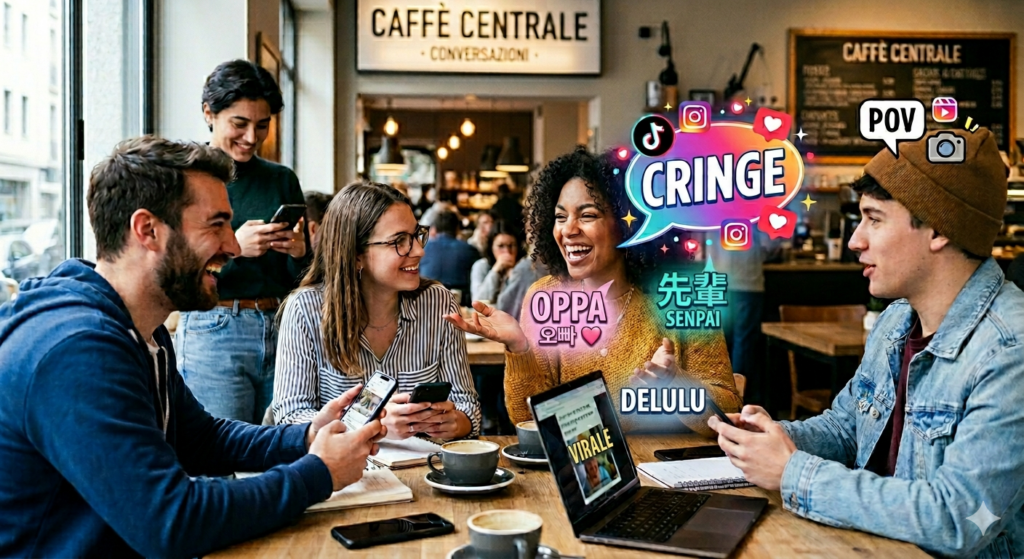
Over the past few years, words like cringe have moved far beyond internet culture and into everyday conversation. In English, to cringe means reacting with embarrassment or discomfort, but online the word is often used for something so awkward that watching it makes you uncomfortable too.
The same thing happened with POV, short for point of view, which exploded on TikTok and Instagram reels. It is commonly used in videos where creators act out situations from a specific character’s perspective, making viewers feel part of the scene. Then there is delulu, an ironic shortening of delusional, now widely used online to joke about unrealistic fantasies or expectations.
The phenomenon goes far beyond English.
From Korean came oppa, a word girls use when talking to an older boy or a man they feel close to. Thanks to the global popularity of K-pop and Korean dramas on social media, even people who do not speak Korean now recognize it instantly.
Japanese gave us senpai, a term for someone older or more experienced within a school, club, or group. Anime, manga, and online memes helped turn it into a familiar word far outside Japan.
A lot of viral expressions spread because they communicate something quickly and effortlessly. They are short, memorable, and often tied to situations people immediately recognize.
Sometimes, though, it is simply the sound of a word that helps it spread. Certain expressions become popular because they are catchy, satisfying to say, or perfectly suited to the fast rhythm of online conversation. After hearing them often enough, they start to feel strangely familiar—as though they have always existed.
People often worry that social media slang is somehow ruining language. In reality, the opposite is true. A healthy language is always evolving. It absorbs outside influences, adapts to cultural shifts, and constantly finds new ways to describe the world around us.
Viral words work a little like cultural trends. They begin in small online communities, spread rapidly across the Internet, and sometimes become part of everyday speech. Some disappear almost immediately. Others stick around.
Change is part of what keeps a language alive.