

Dietro a una pronuncia imprevedibile si nascondono secoli di storia
Se hai studiato inglese, probabilmente almeno una volta l’hai pensato.
Leggi una parola, sei convinto di sapere come si pronuncia e poi scopri che il suono è completamente diverso da quello che immaginavi.
Succede con parole come know, dove la k è muta, oppure con il famigerato gruppo di lettere -ough, che sembra seguire una regola, ma cambia pronuncia quasi ogni volta.
Viene spontaneo chiedersi: perché banalmente l’inglese non si scrive come si pronuncia?
La risposta c’entra poco con la grammatica e molto di più con la storia.
A differenza di altre lingue europee, l’inglese non si è sviluppato in modo lineare.
Le sue origini risalgono alle lingue germaniche portate in Gran Bretagna dagli Anglosassoni intorno al V secolo. Qualche secolo dopo arrivarono i Vichinghi, che introdussero parole e suoni provenienti dall’antico norreno. Nel 1066 fu la volta dei Normanni, che portarono con sé il francese, allora lingua dell’aristocrazia e dell’amministrazione.
Nei secoli successivi l’inglese continuò a trasformarsi, accogliendo influenze dal latino, dalle lingue celtiche e, più avanti, da moltissime altre lingue del mondo.
Il risultato è una lingua che ancora oggi porta i segni di tutte queste contaminazioni.
Come se non bastasse, tra il Quattrocento e il Seicento la pronuncia dell’inglese cambiò profondamente.
Si cominciò a pronunciare in modo diverso le vocali e alcuni suoni scomparvero del tutto. I linguisti chiamano questo fenomeno Great Vowel Shift, cioè “Grande spostamento vocalico”.
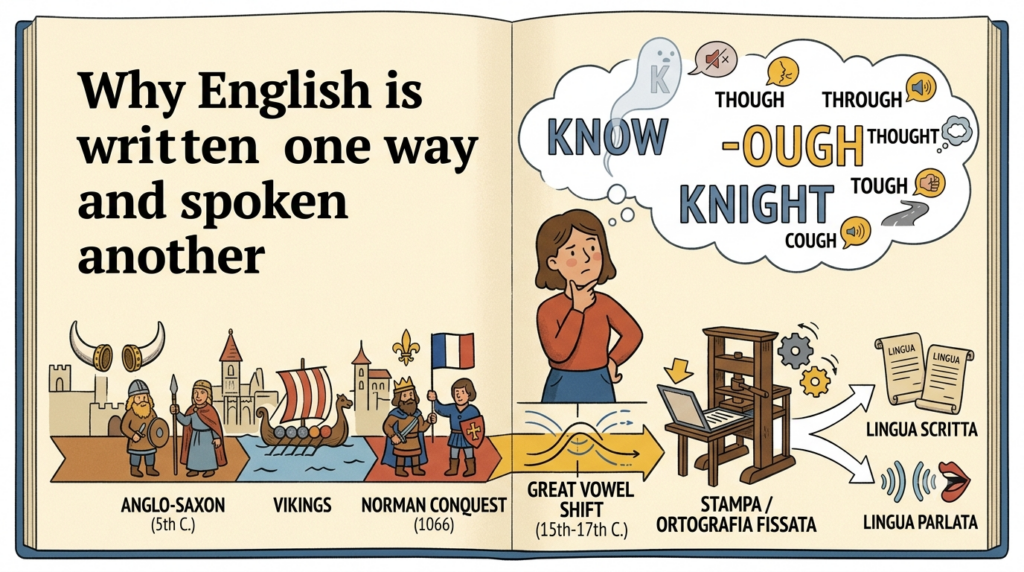
Con l’arrivo della stampa in Inghilterra, i libri iniziarono a essere prodotti in grandi quantità. Per evitare confusione, tipografi e stampatori cercarono di uniformare il modo di scrivere le parole.
L’ortografia si fissò, mentre in parallelo la lingua parlata continuò a evolversi.
È per questo che oggi l’inglese conserva grafie che sembrano poco intuitive: non sono sbagliate, semplicemente fotografano una lingua che risale a diversi secoli fa.
Prendiamo proprio il verbo to know.
Oggi la k iniziale è muta, ma nell’inglese medievale veniva pronunciata. Lo stesso succedeva in parole come knight, knee o knock.
Con il passare del tempo quel suono è scomparso dalla lingua parlata, ma nessuno ha sentito il bisogno di cambiare anche la scrittura.
Quelle lettere mute sono rimaste lì come una traccia del passato.
C’è poi una combinazione di lettere che mette in difficoltà quasi tutti gli studenti di inglese: -ough.
Basta confrontare queste parole:
La grafia è praticamente identica, ma la pronuncia cambia ogni volta.
Il motivo è che queste parole hanno seguito percorsi diversi nel corso dei secoli. Alcune hanno modificato i loro suoni, altre li hanno conservati più a lungo, altre ancora sono state influenzate dai dialetti locali. La scrittura, invece, è rimasta quasi sempre la stessa.
Per chi studia inglese tutto questo può sembrare frustrante.
In realtà, ogni lettera muta e ogni pronuncia “inaspettata” raccontano qualcosa del passato della lingua. Sono il risultato di invasioni, incontri tra popoli, cambiamenti nella pronuncia e di una scrittura che, a un certo punto, ha smesso di rincorrere la lingua parlata.
Ascolta l’articolo in inglese mentre lo leggi
Centuries of history lie behind English’s famously unpredictable pronunciation.
If you’ve ever studied English, you’ve probably had this thought at least once.
You look at a word, you’re sure you know how to pronounce it… and then discover you’ve got it completely wrong.
Think of words like know, where the k is silent. Or take the infamous -ough spelling, which looks as though it should follow a single rule but somehow seems to be pronounced differently every time.
It’s enough to make anyone wonder: why doesn’t English simply spell words the way they’re pronounced?
The answer has surprisingly little to do with grammar—and everything to do with history.
Unlike many other European languages, English didn’t evolve along a single, straightforward path.
Its roots lie in the Germanic languages brought to Britain by the Anglo-Saxons around the fifth century. A few centuries later came the Vikings, bringing words and sounds from Old Norse. Then, in 1066, the Norman Conquest introduced French, the language of the ruling class, the courts, and the administration.
Over the centuries, English continued to absorb influences from Latin, the Celtic languages, and eventually from countless other languages around the world.
The result is the language we know today—one that still carries traces of every stage of its history.
As if that weren’t enough, English pronunciation underwent a dramatic transformation between the fifteenth and seventeenth centuries.
Many vowel sounds shifted, while others disappeared altogether. Linguists know this process as the Great Vowel Shift.
It changed the way English sounded—but not the way it was written.
The invention of the printing press played an important role too.
As books began to be produced on a much larger scale in England, printers needed a more consistent way of spelling words.
Written English gradually became standardized, while spoken English continued to evolve.
That’s why modern English is full of spellings that can seem puzzling today. They’re not illogical—they simply preserve the language as it was spoken centuries ago.
Take the verb to know.
Today, the k is silent. But in Middle English, it was actually pronounced.
The same was true of words like knight, knee, and knock.
Over time, that sound gradually disappeared from everyday speech, but the spelling never changed.
Those silent letters are still there today, quietly preserving a piece of the language’s history.
Then there’s the letter combination that has puzzled generations of English learners: -ough.
Just compare these words:
The spelling is almost identical, yet the pronunciation changes from one word to the next.
That’s because each of these words followed its own path over the centuries. Some sounds changed earlier than others, some remained unchanged for longer, and some were shaped by regional dialects.
The spelling, however, stayed largely the same.
For anyone learning English, all of this can feel frustrating.
But every silent letter and every seemingly unpredictable pronunciation tells part of the language’s story.
They’re the legacy of invasions, cultural exchanges, sound changes, and a writing system that, at a certain point, stopped trying to keep up with the way people actually spoke.
Ascolta l’articolo in francese mentre lo leggi
Derrière une prononciation parfois déroutante se cachent des siècles d’histoire.
Si vous avez déjà appris l’anglais, vous vous êtes sans doute posé cette question au moins une fois.
Vous tombez sur un mot, vous êtes persuadé de savoir le prononcer… puis vous découvrez que vous étiez complètement à côté de la plaque.
Prenez know, par exemple, où le k est muet. Ou encore la célèbre terminaison -ough, qui semble obéir à une règle… avant de se prononcer différemment presque à chaque mot.
De quoi se demander : pourquoi l’anglais n’écrit-il pas tout simplement les mots comme il les prononce ?
La réponse tient finalement beaucoup moins à la grammaire qu’à l’histoire.
Contrairement à bien d’autres langues européennes, l’anglais ne s’est pas construit de manière linéaire.
Ses origines remontent aux langues germaniques apportées en Grande-Bretagne par les Anglo-Saxons au Ve siècle. Quelques siècles plus tard, les Vikings y ont introduit des mots et des sonorités issus du vieux norrois. Puis, en 1066, la conquête normande a fait entrer le français, qui était alors la langue de la noblesse, de la justice et de l’administration.
Au fil des siècles, l’anglais a continué de s’enrichir au contact du latin, des langues celtiques, puis d’innombrables autres langues venues des quatre coins du monde.
La langue que nous connaissons aujourd’hui garde encore les traces de toutes ces influences.
Comme si cela ne suffisait pas, la prononciation de l’anglais a profondément évolué entre le XVe et le XVIIe siècle.
De nombreuses voyelles ont changé de son, tandis que d’autres sons ont tout simplement disparu. Les linguistes appellent ce phénomène le Great Vowel Shift, ou « grande mutation vocalique ».
Cette transformation a bouleversé la façon de parler… mais pas celle d’écrire.
L’invention de l’imprimerie a elle aussi joué un rôle décisif.
Avec la production de livres à grande échelle en Angleterre, les imprimeurs ont cherché à harmoniser l’orthographe des mots.
Peu à peu, l’anglais écrit s’est fixé, tandis que la langue parlée continuait d’évoluer.
C’est pourquoi l’anglais moderne conserve aujourd’hui des graphies qui peuvent sembler déconcertantes. Elles ne sont pas illogiques : elles reflètent simplement l’état de la langue tel qu’il était il y a plusieurs siècles.
Prenons le verbe to know.
Aujourd’hui, le k initial ne se prononce plus. Pourtant, en moyen anglais, il était bel et bien articulé.
Il en allait de même pour des mots comme knight, knee ou knock.
Au fil du temps, ce son a disparu de la langue parlée, mais l’orthographe, elle, est restée inchangée.
Ces lettres muettes sont donc toujours là, témoins silencieux du passé de la langue.
Il existe ensuite une combinaison de lettres qui donne du fil à retordre à des générations d’apprenants : -ough.
Il suffit de comparer ces mots :
L’orthographe est presque identique, mais la prononciation change d’un mot à l’autre.
La raison est simple : chacun de ces mots a suivi sa propre évolution au fil des siècles. Certains sons se sont transformés plus tôt, d’autres sont restés plus longtemps inchangés, et certains ont été influencés par les dialectes régionaux.
L’orthographe, en revanche, a très peu évolué.
Pour les personnes qui apprennent l’anglais, tout cela peut sembler frustrant.
Pourtant, chaque lettre muette et chaque prononciation qui paraît imprévisible racontent un morceau de l’histoire de la langue.
Elles sont l’héritage des invasions, des rencontres entre les peuples, des évolutions de la prononciation et d’un système d’écriture qui, à un moment donné, a cessé de suivre les changements de la langue parlée.